Join Our FacebookGroup & Get Extra Discount!ContactBlog

Hit & miss
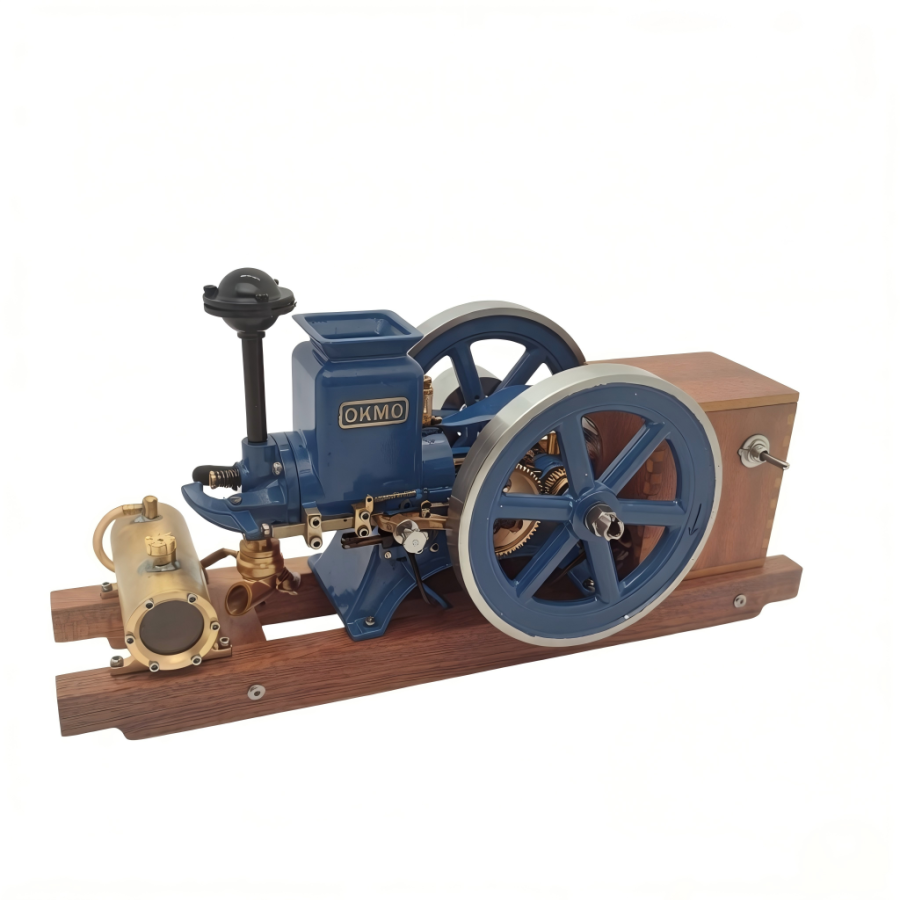
Why the OKMO B02 Horizontal Hit-and-Miss Is "Built to Be Simple"
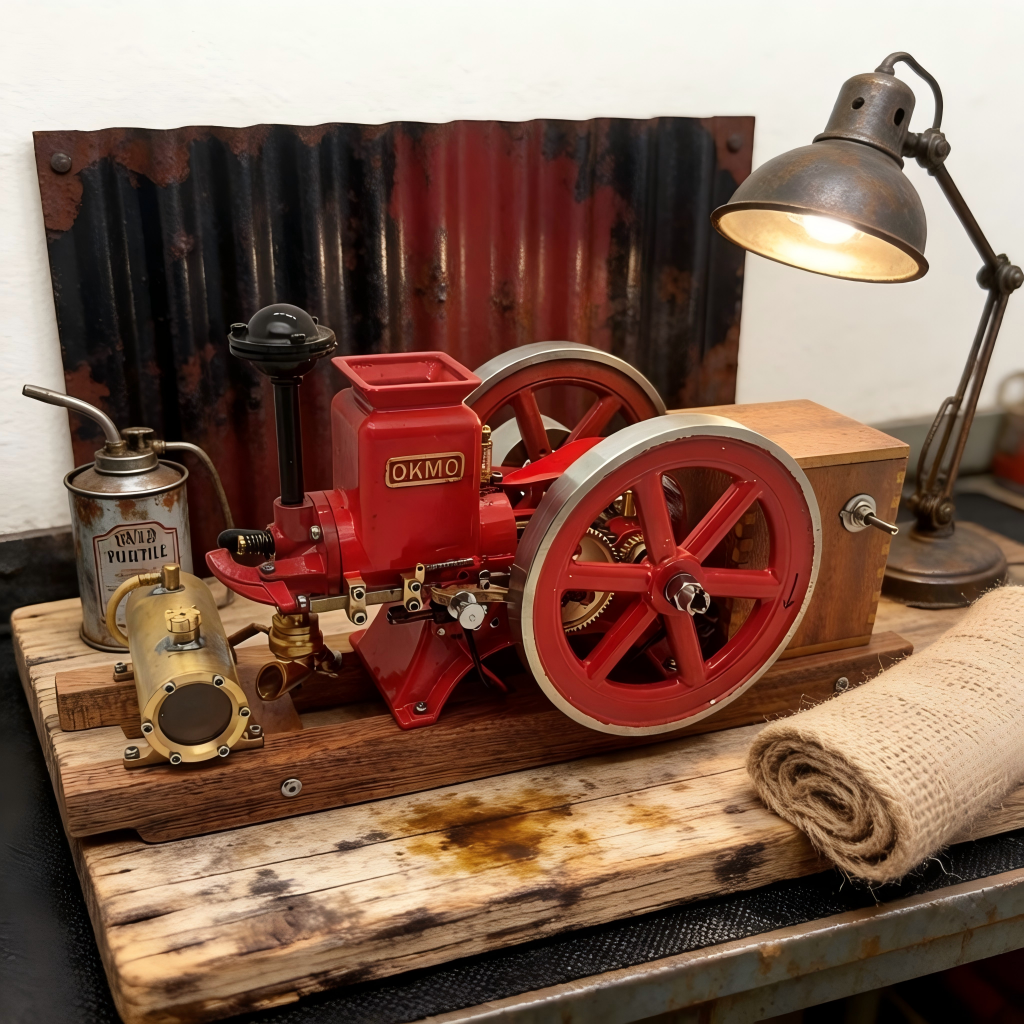
B02 Engine Special A Red Metal Block Smaller Than Your Palm: The Complete DNA of Farm Mechanization—Why the OKMO B02 Horizontal Hit-and-Miss Is "Built to Be Simple"
1. Its Ancestors: The "Second Heart" of Rural America Before Electricity
If you look at North American and European villages in the early 1900s as a system, steam engines were too big and finicky, and horses were too slow and expensive to feed. What farmers really needed wasn't "high tech," but a reliable iron brute that could sit in one spot all day and send power via a flat belt to pumps, grinders, saws, and separators.
This is the exact context where the Hit-and-Miss engine appeared.
Timeline | What Happened |
|---|---|
1876 | German engineer Nikolaus Otto finalized the four-stroke Otto cycle (Intake → Compression → Power → Exhaust), laying the foundation for all piston gasoline engines. |
~1894 | The first commercial Hit-and-Miss engines emerged—essentially binding the Otto cycle to a centrifugal flyball governor, using a logic of "fire one—coast a few—fire again" to regulate speed decades before electronics existed. |
1900s–1920s (The Golden Era) | It became the "power plant" of the farm: driving well pumps, corn shellers, feed grinders, buzz saws, cream separators, washing machines, and small generators. Many were mounted on wooden/iron skids; you pushed the engine to the center of the yard, and every belt on the farm eventually connected to it. |
1930s–40s | Throttle-governed, enclosed-crankcase, air-cooled designs (like early Briggs & Stratton) gradually replaced them. During WWII, countless originals were scrapped for metal—every surviving original today is a relic of that transition. |
Why "Hit-and-Miss"?
It’s not about missing a shot—quite the opposite:
Hit: Flywheel speed drops below the setpoint → Governor releases → Intake valve closes normally → Cylinder pulls in charge → Compression → Spark → BOOM → One real power stroke.
Miss: Flywheel spins too fast → Governor holds the exhaust valve slightly open → No vacuum on intake → No mixture enters → Spark doesn’t even try → The piston just coasts through.
So that iconic rhythm—
Pop—whoosh-whoosh-whoosh—Pop—whoosh-whoosh...
—is not a malfunction. It is a purely mechanical closed-loop control system working in real time. No ECU, no throttle butterfly, just a flyball thinking in centrifugal force and a spring pulling back.
2. The B02’s Horizontal Layout: Engineering Language, Not Just Aesthetic
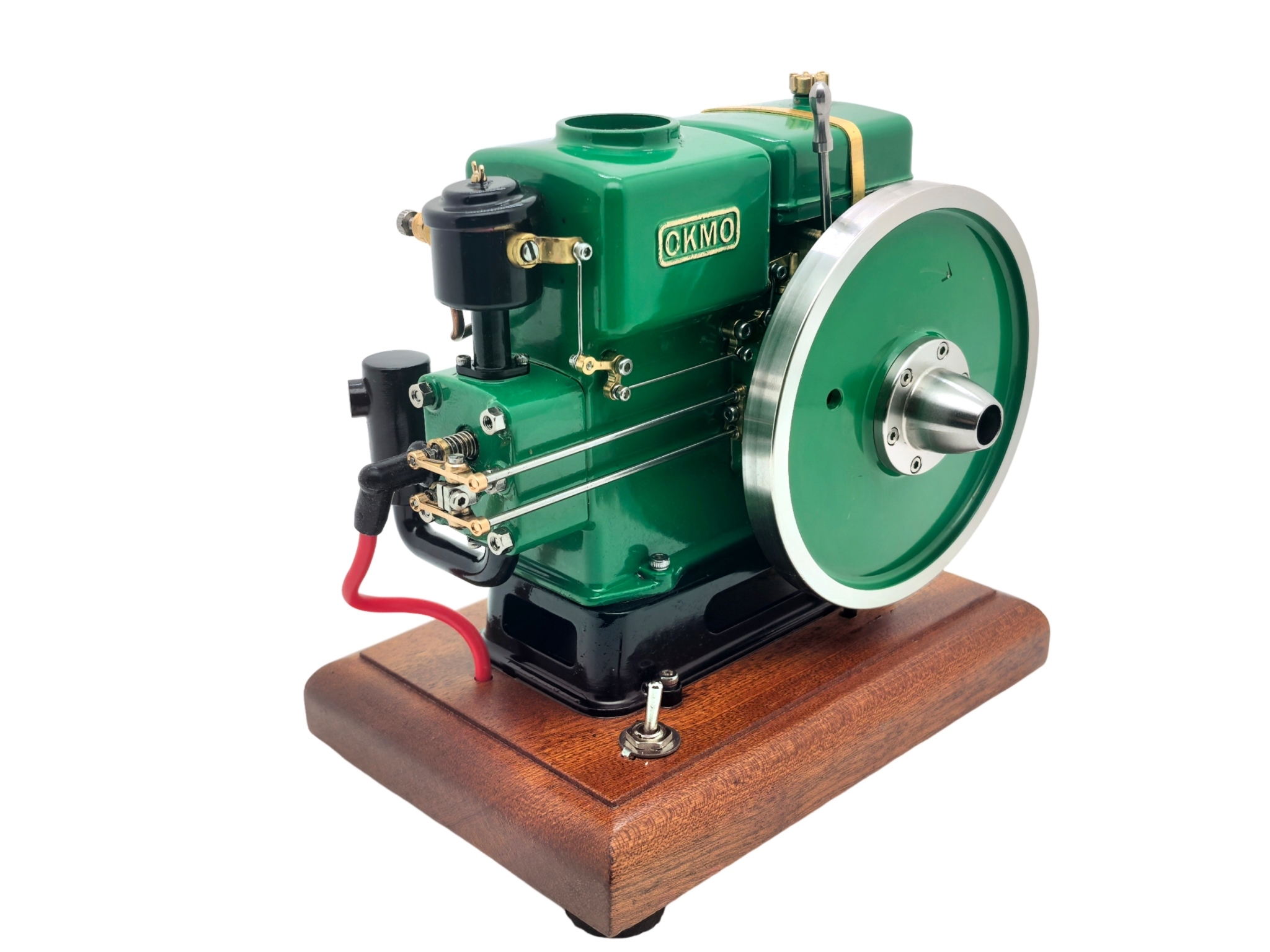
The OKMO B02 compresses that entire bloodline into a footprint of 25.5 × 11 × 13 cm / 2 kg:
Item | B02 Spec | What It Tells You |
|---|---|---|
Layout | Horizontal Single-Cylinder · Four-Stroke | Low center of gravity, long-stroke visual, honest power transfer—originals lay down too |
Displacement | 3.6cc (Bore 16mm × Stroke 19mm) | Roughly the 1/4-scale spirit of a 1–3 HP antique |
Cooling | Evaporative Water Cooling (jacket evaporates heat away) | No water pump, no thermostat, no radiator—heat leaves by boiling off |
Lubrication | Splash Lubrication · Mixed-Oil Route | No oil pump, no filter, no gallery blockages—oil mist from crank sling is the whole system |
Ignition | Mechanical Contact Control Ignition + Wooden Battery Box (1×AA 1.5V) | No chip—points opening and closing isthe signal |
Fuel | Gasoline 92#↑ + 4T Oil | "Kitchen-grade" fuel |
Starting | Hand-flip / Drill Assist | No starter motor required |
Construction | All-metal · Red paint · Wooden base | Echoes the original "skid mount" tradition |
3. Why It Is "Naturally Easy to Maintain"—Explained by Mechanism
Many people hear "real internal combustion engine" and expect nightmares. The B02 hits the sweet spot of "alive, but structurally minimal." It isn’t easy because it’s crude—it’s easy because the old design stripped complexity to the bone:
❶ Lubrication: No Oil Pump = No Oil Pump Failure
The splash lubrication logic is brutally simple and honest:
Crankshaft spins → Through the connecting rod hole → Flings oil mist → Mist lands on cylinder walls/bearings/cams.
You only manage one thing: oil level. No pump = no pump failure. No filter = no clogging. No pressure sensor = no false alarms. Check it before running, drip a little after, done.
❷ Cooling: Evaporative Jacket, Near-Zero Parts Count
No water pump, no fan clutch, no maze of coolant hoses. One water jacket, one fill port, one evaporation surface—hot = self-cools; cold = stops cooling. Your only job: don’t let it run dry (check level before running; drain after to prevent scale and rust).
❸ Speed Control: A Flyball + Linkage = The Whole "ECU"
Modern engines need MAP tables, TPS sensors, O2 sensors to hold idle. The B02’s governor is physical centrifugal force:
Part count: one spring + a pair of flyweights + a pushrod → linked to the exhaust valve
Adjustability: preload on one spring (sets how fast it wants to spin)
Failure mode: mechanical sticking (solution = a drop of light oil + working the linkage by hand, cheaper than flashing an ECU)
❹ Ignition: Contact Points = Diagnosable by Touch
The B02 uses the classic make-and-break mechanical contact concept (battery box supply → points interrupt to fire the plug). The advantage:
Modern Electronic Ignition | B02 Mechanical Contacts |
|---|---|
TCI fails = mystery box | Oil on the contact points = visible to the naked eye; simply blot it dry with a tissue. |
Needs scope/meter for signals | Gap adjustment + hand-feel restores operation |
Obsolete = dead unit | Copper contacts/springs/insulators are fundamentally reproducible |
❺ Fully Exposed = Fully Accessible
Its connecting rod, flywheel spokes, valve rocker, and lube points are all on the outside. Which pin is dry, you can see; which joint weeps, you can feel. Maintenance is looking, not disassembling.
4. The Actual B02 Maintenance Checklist (Just Six Things)
Writing it clearly is more reassuring than claiming "maintenance-free"—buyers of this model want life, not zero responsibility.
Frequency | Action | Why |
|---|---|---|
Before Every Run | ① Check water jacket level (fill ≤ 2/3) | Prevent dry running, seizing, lean seizure |
During Run | Keep hands/hair away from flywheel/rod | It’s a stationary character by nature |
After Shutdown | Let cool naturally → Drain water jacket → Wipe condensation/oil mist | Prevent scale + corrosion + tidy desk |
Every 3–5 Runs | ① Inspect contact points | Keep firing crisp |
Long-Term Storage | Empty fuel → Drain water → Light oil film on moving parts → Cover | Next time, it wakes up ready |
Notice what’s missing: no "change oil filter," no "clean throttle body," no "read fault codes." Not because it’s primitive, but because its design philosophy never required those layers.
5. One Sentence That Ties "History" and "Easy Care" Together
It comes from an age before computers, so all its intelligence stays where you can see it, touch it, and bring it back to life with a drop of oil and a screwdriver.
3users like this.
新品




 USD

Your cart is currently empty.